Five Open-Source Algorithmic Trading Bots and Engines for Crypto and Forex: Freqtrade, Hummingbot, Jesse, LEAN, and NautilusTrader
A technical comparison of five notable open-source algorithmic trading projects for crypto and forex, covering architecture philosophy, GitHub age, backtesting, paper trading, live execution, licenses, and official repositories for Freqtrade, Hummingbot, Jesse, QuantConnect LEAN, and NautilusTrader.
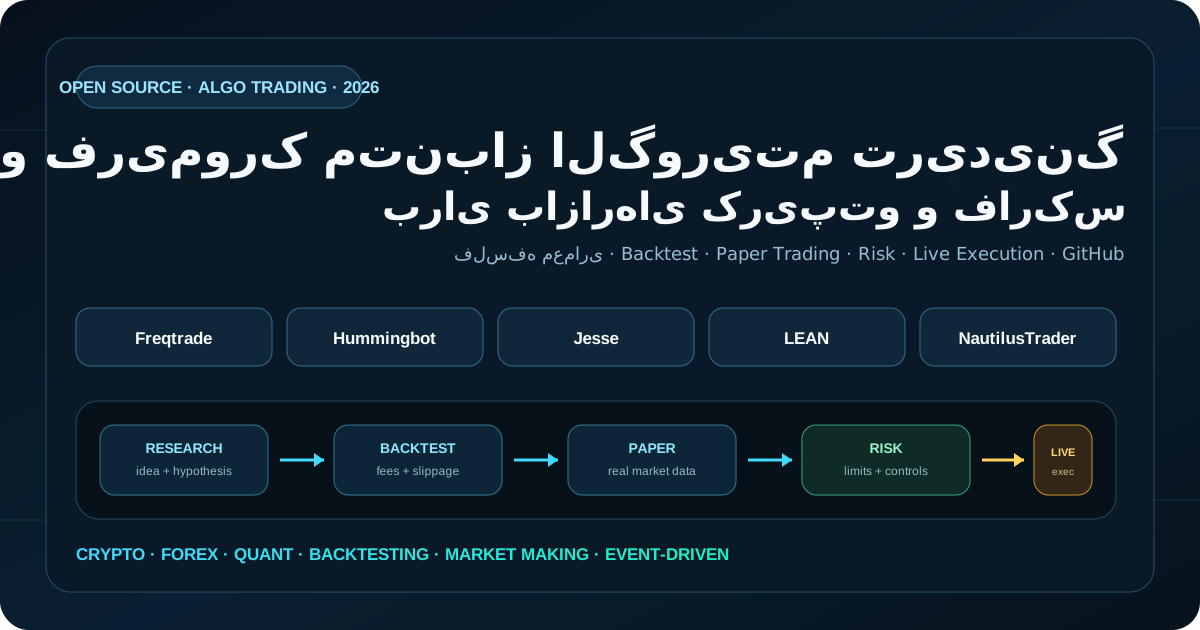
Introduction: What Does an Algorithmic Trading Bot Actually Do?
An open-source algorithmic trading bot is more than a script that buys when two moving averages cross. A robust system usually separates market data, signal generation, risk controls, order management, fill reconciliation, fees, portfolio state, and monitoring.
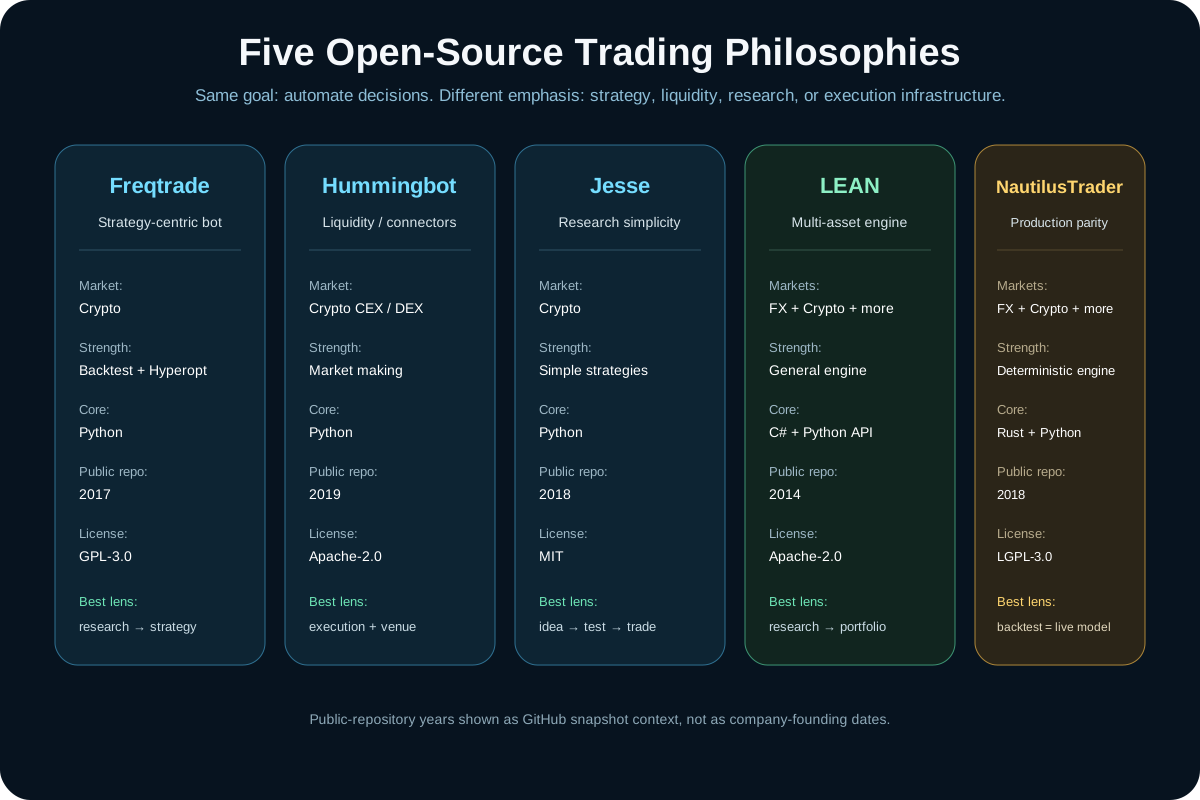
This article compares five notable projects—Freqtrade, Hummingbot, Jesse, QuantConnect LEAN, and NautilusTrader—not as an absolute ranking, but as five different engineering philosophies used across crypto and forex algorithmic trading.
Important: no bot, framework, or backtest guarantees future profitability. Real deployments must account for fees, slippage, funding, latency, execution quality, risk controls, and market-regime changes. Paper trading or dry-run should precede real capital.
Comparison Snapshot — September 2026
Repository age below uses the public GitHub repository creation date, not the company founding date. Stars are a September 21, 2026 snapshot and are not a quality or profitability score.
| Project | Main focus | Markets | Core | Public repo since | Approx. age | License | Stars* |
|---|---|---|---|---|---|---|---|
| Freqtrade | Strategy bot, backtest, hyperopt | Crypto | Python | May 17, 2017 | ~9.3y | GPL-3.0 | ~54.6k |
| Hummingbot | Market making, connectors | Crypto CEX/DEX | Python | Apr 2, 2019 | ~7.5y | Apache-2.0 | ~20.1k |
| Jesse | Research, backtest, paper/live | Crypto | Python | Nov 9, 2018 | ~7.9y | MIT | ~8.6k |
| QuantConnect LEAN | Multi-asset engine | Forex, Crypto, Equities, Futures, more | C# + Python/C# | Nov 28, 2014 | ~11.8y | Apache-2.0 | ~21.7k |
| NautilusTrader | Production event-driven engine | FX, Crypto, multi-asset | Rust + Python/Rust | Jun 25, 2018 | ~8.2y | LGPL-3.0 | ~29.2k |
The Core Philosophy: The Bot Does Not Create the Edge
Serious trading frameworks separate strategy from infrastructure.
Market Data → Signal / Statistical Edge → Portfolio & Risk Rules → Order Generation → Execution → Fills & Position Reconciliation → Monitoring → Research
A framework makes this loop testable, repeatable, and observable. Whether a strategy retains edge in future markets is a separate research problem.
1. Freqtrade — Strategy-First Crypto Automation
Freqtrade is one of the best-known open-source crypto trading bots. It focuses on Python strategy definition, historical backtesting, parameter optimization, dry-run testing, and live execution.
Strengths: Python/Pandas strategies, built-in backtesting, Hyperopt, dry-run mode, WebUI/Telegram, and a direct research-to-deployment workflow.
Philosophy: Freqtrade is best viewed as a strategy research bot. It is a natural fit when the central problem is testing and operating systematic crypto strategies.
2. Hummingbot — Liquidity, Connectors, and Market-Making Execution
Hummingbot is strongly associated with market making, arbitrage, order-book logic, and multi-venue crypto execution. Its connectors normalize exchange and blockchain APIs.
Strategy V2 uses modular components such as Candles, Controllers, and Executors. Dashboard backtesting and paper trading support a research-to-deployment workflow.
Philosophy: Hummingbot is execution-centric: it pays close attention to how automated strategies interact with venue structure, spreads, inventory, fills, and order lifecycle.
- GitHub
- Docs
- Backtesting
- Paper Trading
- Public repo created: Apr 2, 2019
3. Jesse — Simplifying Research to Paper and Live Trading
Jesse is an advanced crypto trading framework that emphasizes readable Python strategy code, multi-symbol and multi-timeframe research, backtesting, optimization, risk tooling, and paper/live trading.
Philosophy: Jesse tries to shorten the distance between an idea and a structured trading experiment.
4. QuantConnect LEAN — A General Multi-Asset Trading Engine
LEAN is an algorithmic trading engine rather than a single-market bot. The core is C#, while strategies can be written in C# or Python.
Official documentation covers Forex and Crypto alongside Equities, Futures, Options, and CFDs. LEAN also exposes configurable fee, fill, slippage, and margin models.
Philosophy: LEAN is a general-purpose quant engine where market data, portfolio state, brokerage integration, transaction models, and execution semantics are first-class components.
- GitHub
- Docs
- Brokerages
- Public repo created: Nov 28, 2014
5. NautilusTrader — Backtest-to-Live Parity and Event-Driven Correctness
NautilusTrader is an open-source, production-grade engine with a Rust-native core and Python/Rust APIs.
Its central goal is to reduce divergence between deterministic simulation and live execution by using consistent event, time, cache, and execution semantics.
Philosophy: NautilusTrader is execution infrastructure with research/live parity. It is particularly relevant when correctness, event ordering, state recovery, and multi-venue architecture matter as much as the strategy signal.
- GitHub
- Docs
- Integrations
- Public repo created: Jun 25, 2018
Five Philosophies at a Glance
| Project | Primary architecture question | Best fit |
|---|---|---|
| Freqtrade | How do I research and optimize a crypto strategy? | Systematic crypto |
| Hummingbot | How do I manage liquidity and execution across venues? | Market making, arbitrage |
| Jesse | How do I move from idea to backtest/live with less boilerplate? | Python crypto research |
| LEAN | How do I model multiple asset classes and brokerages? | Forex/Crypto multi-asset quant |
| NautilusTrader | How do I minimize differences between backtest and live semantics? | Production event-driven systems |
Backtesting: Where Many Systems Become Unrealistic
A useful backtesting engine should account for fees, spread, slippage, funding, latency, partial fills, look-ahead bias, and overfitting.
A beautiful equity curve is not evidence that a strategy will survive real execution.
Paper Trading Should Sit Between Backtest and Live
Paper trading should validate real-time data, state management, stop-loss/take-profit behavior, reconnects, restart recovery, logging, alerts, fee/funding accounting, and order lifecycle.
Paper trading can still be optimistic, so it does not replace realistic execution modeling.
Risk Management Is Not the Strategy
Independent limits should include maximum risk per trade, maximum daily loss, maximum exposure, maximum leverage, circuit breakers, stale-data protection, and exchange/API failure handling.
A signal strategy should not have unlimited authority to create exposure.
Crypto vs Forex
Crypto is 24/7, fragmented across exchanges, often includes perpetual funding, and has exchange/API/custody-specific risks.
Forex has trading sessions, broker/ECN execution models, variable spreads, rollover/swap, leverage rules, quote conventions, and potentially meaningful demo/live differences.
This is why a strong crypto bot is not automatically a strong forex bot.
How to Evaluate an Open-Source Trading Bot
Review recent commits, documentation, license, connectors, backtest assumptions, cost modeling, paper trading, risk controls, recovery, tests/CI, secret management, observability, and trade auditability.
A Sensible Development Path
Hypothesis → Historical Data Validation → Realistic Backtest → Out-of-Sample → Walk-Forward → Paper Trading → Tiny-Risk Live → Monitoring → Gradual Scaling
The goal is not to produce a beautiful equity curve. The goal is to test whether the strategy behaves robustly under different conditions.
Security
Before connecting real API keys, disable withdrawal permission, never commit secrets, use IP allowlists where possible, grant minimum permissions, inspect logs for leakage, and keep dependencies and container images updated.
Conclusion
These open-source projects represent different views of trading-system engineering.
Freqtrade emphasizes crypto strategy workflows.
Hummingbot emphasizes liquidity and multi-venue execution.
Jesse emphasizes simple Python research-to-live workflows.
LEAN provides a broad multi-asset engine that includes Forex and Crypto.
NautilusTrader emphasizes deterministic event-driven infrastructure and backtest/live consistency.
The right choice depends on market, strategy type, latency needs, operational complexity, broker or exchange support, and risk architecture.
This article is educational and does not provide investment advice or guarantee the performance of any strategy or software.

Comments
Loading comments...