Xigma AlgoBot — Algorithmic Trading R&D Platform
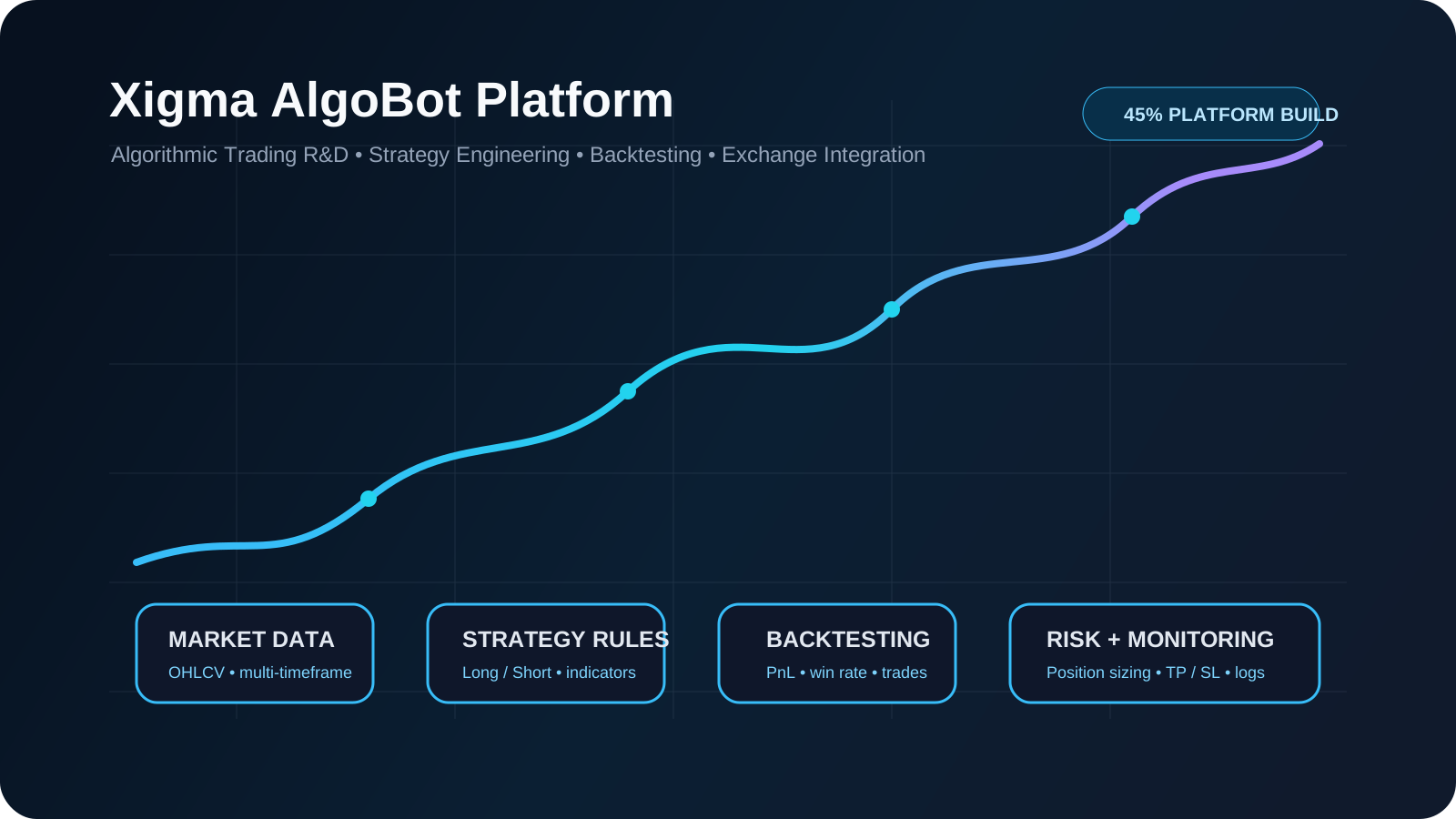
An R&D platform for designing, testing and observing crypto algorithmic-trading strategies with multi-exchange connectivity, parameterized indicators, strategy rules, historical data, backtesting and risk controls. The platform is 45% complete after five months of engineering, built on roughly three years and eight months of prior research.
Project overview
Xigma AlgoBot Platform combines two tracks: roughly 3 years and 8 months of algorithmic-trading R&D, focused largely on crypto markets, and about 5 months of focused platform engineering. The software platform is currently 45% complete.
It is not presented as a guaranteed-profit bot. The goal is a research operating system for strategy engineering: turn hypotheses into explicit rules, manage historical datasets, run repeatable backtests, measure results and iterate.
Domain architecture
The backend currently has seven main domains: Account, Financial, Exchanges, Indicators, Strategy, Backtesting and Report. Django REST Framework exposes the APIs and Swagger/ReDoc documents them.
Exchange foundation
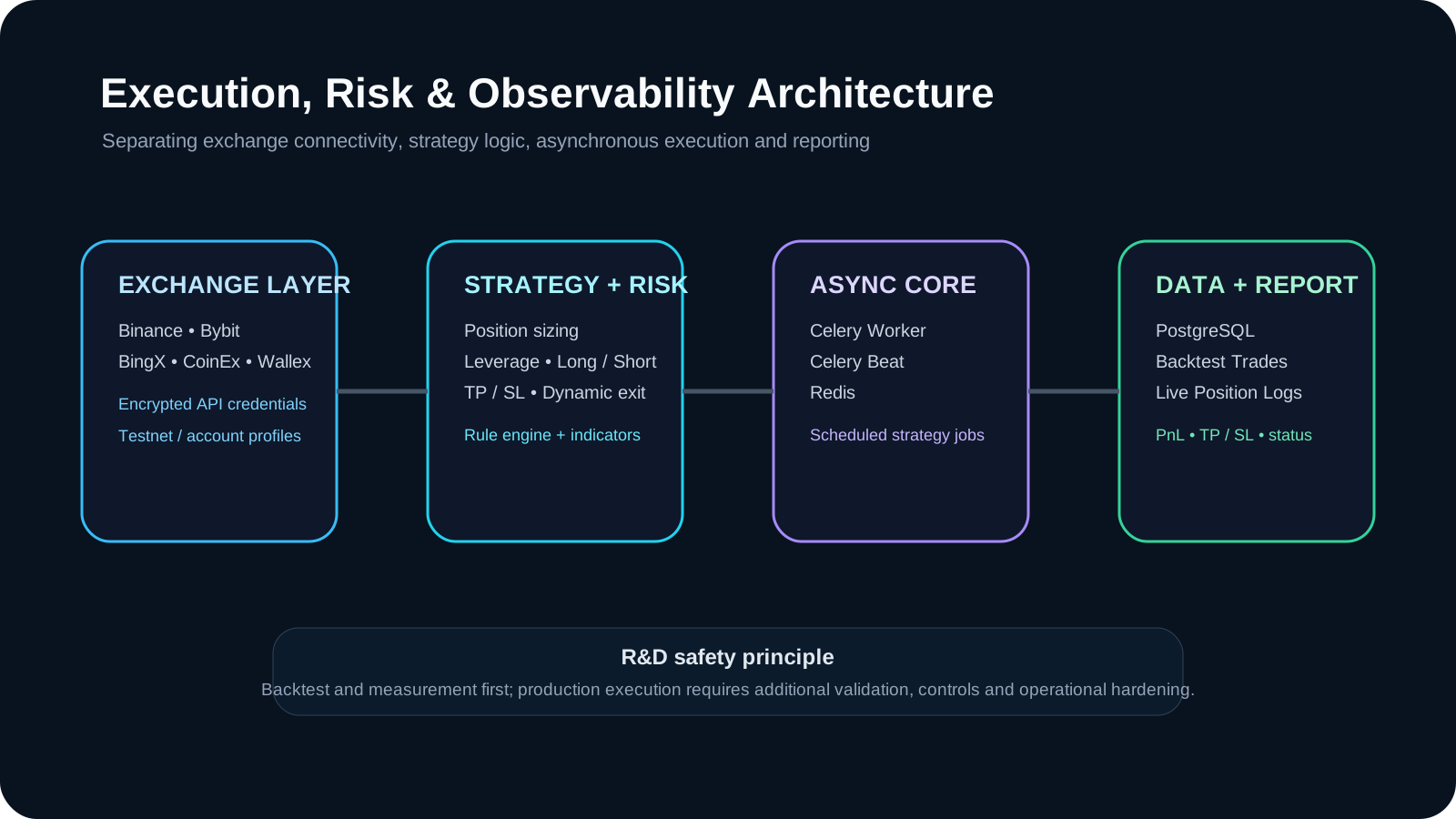
Exchange profiles currently model Binance, Bybit, BingX, CoinEx and Wallex. A user can keep multiple named accounts, credentials are encrypted before persistence, testnet state is modeled, and CCXT provides a common connectivity layer.
Strategy and rule model
A Trading Strategy stores exchange account, symbol, timeframe, Spot vs Perpetual/Futures, Long vs Short, leverage, percentage-based position sizing, stop loss, take profit, dynamic-exit configuration and execution health metadata.
Rules are separate entities and can represent Entry or Exit conditions. Indicator parameters can be overridden per strategy, while the model also provides a foundation for threshold and indicator-to-indicator comparisons.
Data-driven indicators
Technical Tools store name, code, category, default parameters and param_schema. Categories cover trend indicators, oscillators and price-action/pattern tools. The schema is intended to let the Next.js UI generate parameter controls dynamically instead of hardcoding every indicator form.
Historical data and backtesting
OHLCV candles are unique by exchange, symbol, timeframe and timestamp. DataDownloader models historical-download jobs over a selected date range.
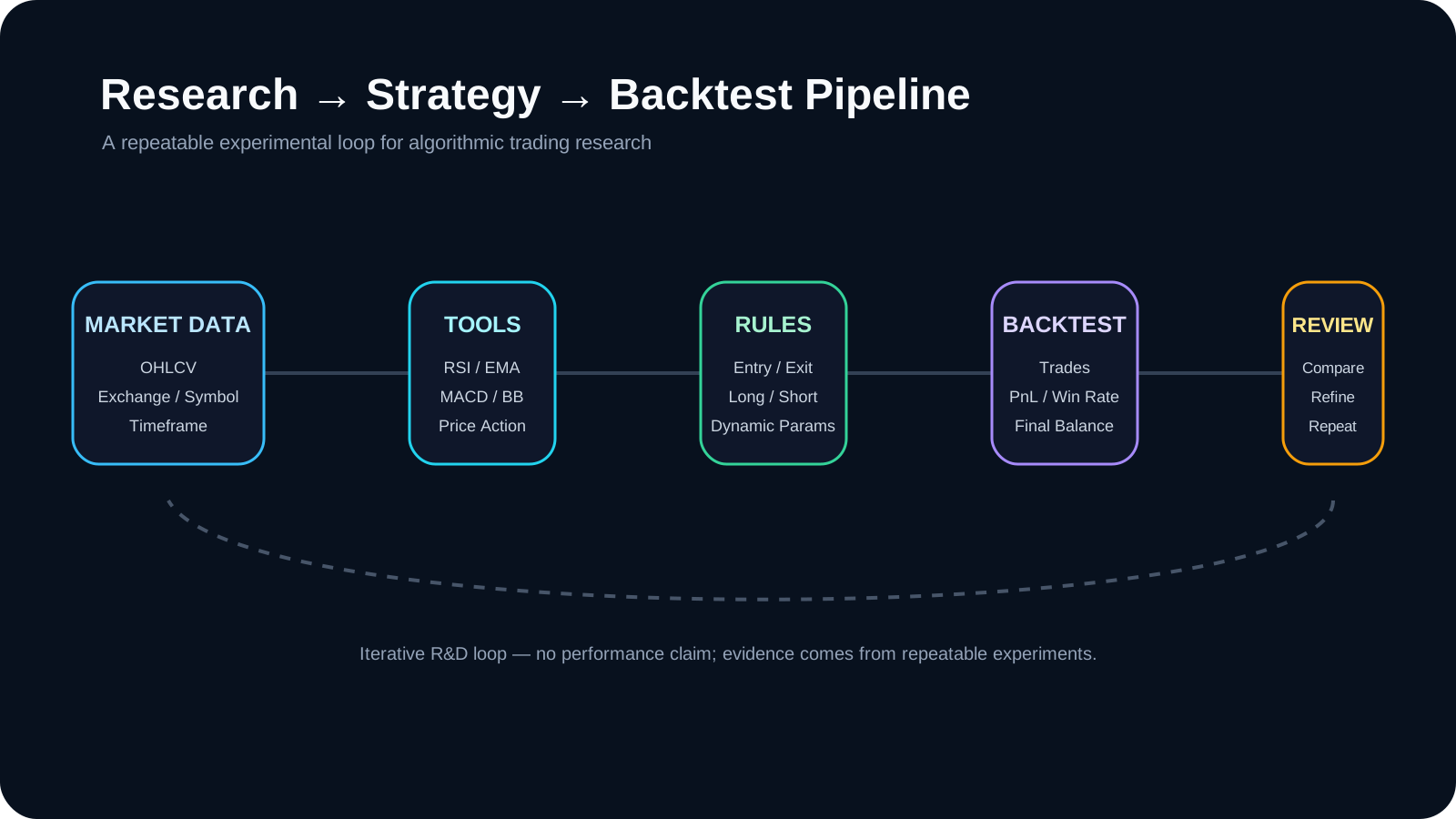
The current backtesting vertical slice loads historical candles, runs the technical analyzer, evaluates entry rules, applies position sizing and leverage, exits primarily via TP/SL, stores each simulated trade and writes summary metrics including total trades, win rate, total PnL and final balance.
The current engine is intentionally not described as final. It executes a subset of simple operators such as LESS_THAN, GREATER_THAN and EQUALS; richer cross semantics, complete indicator comparisons, advanced exit rules and market-microstructure simulation remain future work.
Risk and observability
Position sizing, leverage, stop loss, take profit, dynamic exits and directional side are modeled separately from signal logic. LivePositionLog stores strategy/symbol/side, entry and current prices, PnL percentage, TP/SL, open state and update time as a foundation for runtime monitoring.
Async and infrastructure
Celery Worker, Celery Beat and Redis support scheduled/background work. PostgreSQL stores persistent state. The Docker Compose environment includes backend, frontend, PostgreSQL, Redis, workers, Nginx and Mailpit.
Frontend
The frontend uses Next.js 16, React 19 and TypeScript with Emotion, Framer Motion, Lightweight Charts and next-intl. Public/auth/profile/pricing foundations exist; dedicated Strategy, Backtest and Monitoring workspaces are still part of the remaining product scope.
Financial / SaaS foundation
An early commercial layer models USDT wallets, subscription plans, maximum active-strategy limits, user subscriptions, deposit/withdrawal/subscription transactions and discount codes. It is a foundation, not production-ready billing.
Research timeline
The 3 years 8 months refers to research that predates this repository: indicator behavior, timeframe sensitivity, Spot vs Perpetual markets, Long/Short asymmetry, sizing/leverage, stop/target design, reproducibility, overfitting risk and the gap between historical simulation and real execution.
The software platform itself has been under focused development for about 5 months and is 45% complete.
Engineering strengths
The current foundation is research-first rather than signal-first; strategies and rules are persisted as data, indicator configuration is parameterized, backtests retain lineage to simulated trades, exchange profiles are separated from strategy definitions, asynchronous workers are first-class infrastructure, and financial concerns are separated from the trading core.
Remaining 55%
The largest remaining scope includes realistic fees/slippage/funding and order execution assumptions; out-of-sample and walk-forward validation; robust strategy-language semantics; paper trading; hardened live order state/reconciliation/retry/kill-switch controls; secrets, audit, observability and deployment hardening; plus full Strategy Builder, Backtest, comparison and live-monitoring workspaces.
Platform value
The value proposition is a foundation for a research operating system for strategy engineering:
Data → Tools → Hypothesis → Rules → Backtest → Metrics → Review → Iterate
The long-term goal is to move research knowledge out of disconnected notebooks and scripts into reproducible, inspectable and comparable platform artifacts.
Technology stack
Backend: Python, Django 5, Django REST Framework, SimpleJWT, CCXT, NumPy, pandas, pandas-ta, cryptography
Data & async: PostgreSQL 16, Redis 7, Celery, Celery Beat
Frontend: Next.js 16, React 19, TypeScript, Emotion, Framer Motion, Lightweight Charts, next-intl
Infrastructure: Docker Compose, Nginx, Gunicorn, Swagger/ReDoc
Current status
Algorithmic-trading R&D: ~3 years 8 months
Platform development: ~5 months
Platform progress: 45%
Status: Active R&D / In Progress
Repository: Private
Primary focus: Crypto algorithmic-trading research
Backtests and historical simulations are engineering evidence for evaluating strategies. They are not guarantees of future performance or investment recommendations.
Discussion & comments
Loading comments...