Kerman Khodro Integrated Vehicle Transportation Platform
A multi-role enterprise platform for the complete vehicle-transport lifecycle: origin parking, load marketplace, parent-company approval, driver/truck assignment, live tracking, QR dealer handover, damage and returns, management reporting, plus a native Android driver application.
Project overview
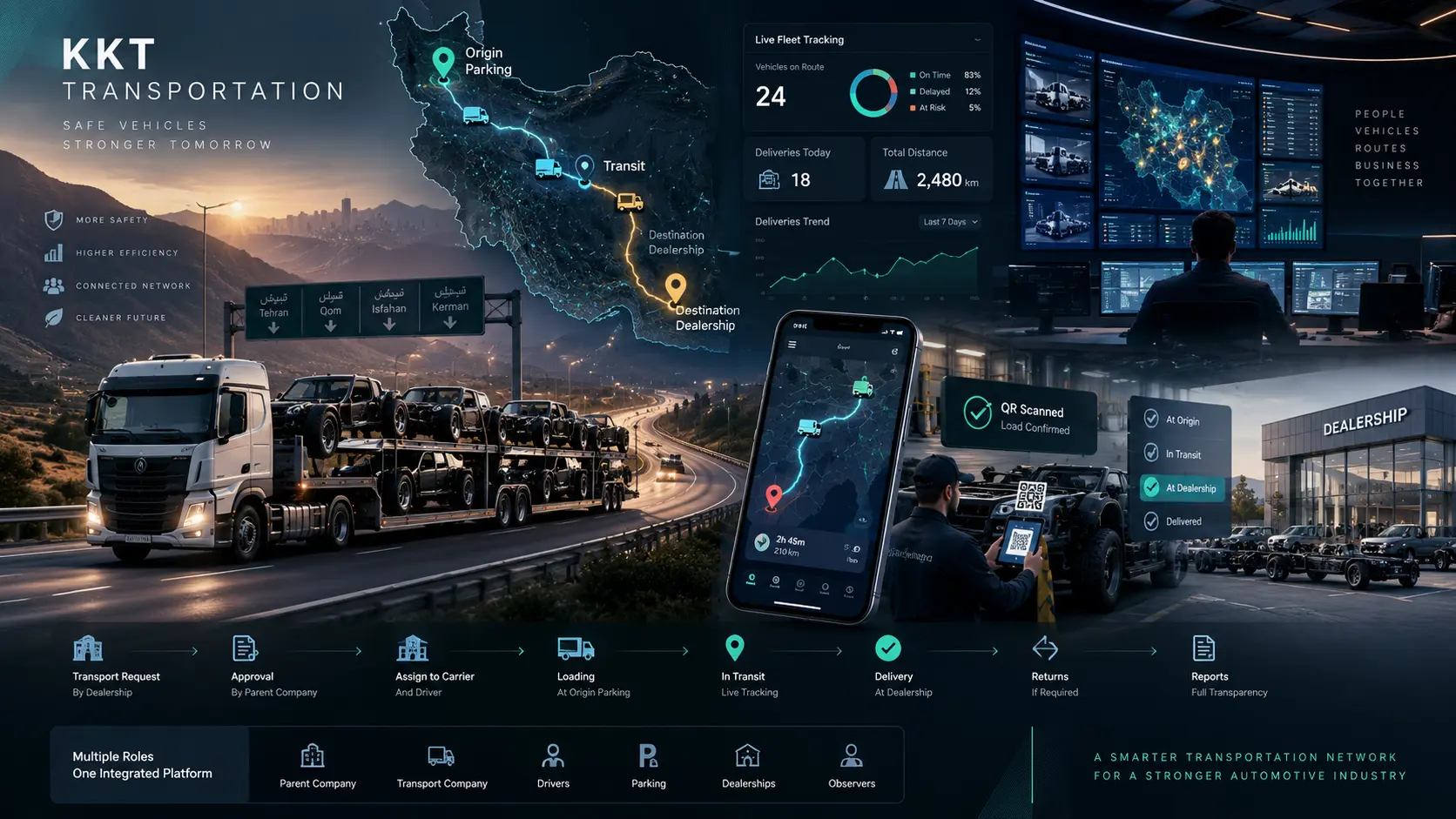
KKT is an enterprise vehicle-transport operations platform built for the real organisational structure of transportation companies: one governing parent company, operational carriers, origin parking terminals, destination dealerships, drivers, tractors and individual vehicle chassis.
The delivered scope goes beyond shipment forms. It digitises the decision chain and the physical chain of custody, creating a traceable operating model from load publication to final dealer acceptance and reverse logistics.
Stable release 1.6.0 completes the driver marketplace and trip-history scope on top of the security, live tracking, custody, QR and exclusive-resource controls delivered in earlier releases. This case study documents that delivered scope as a 100% completed operational product.
The business problem
Vehicle logistics needs several parties to agree on the same physical reality: where a chassis is, which carrier owns the responsibility, which driver and tractor are allowed to move it, when custody changed, whether it arrived damaged, and where it should go if the dealer requests a return.
KKT replaces fragmented calls, spreadsheets and isolated records with one operational source of truth and server-enforced workflows.
Operating model
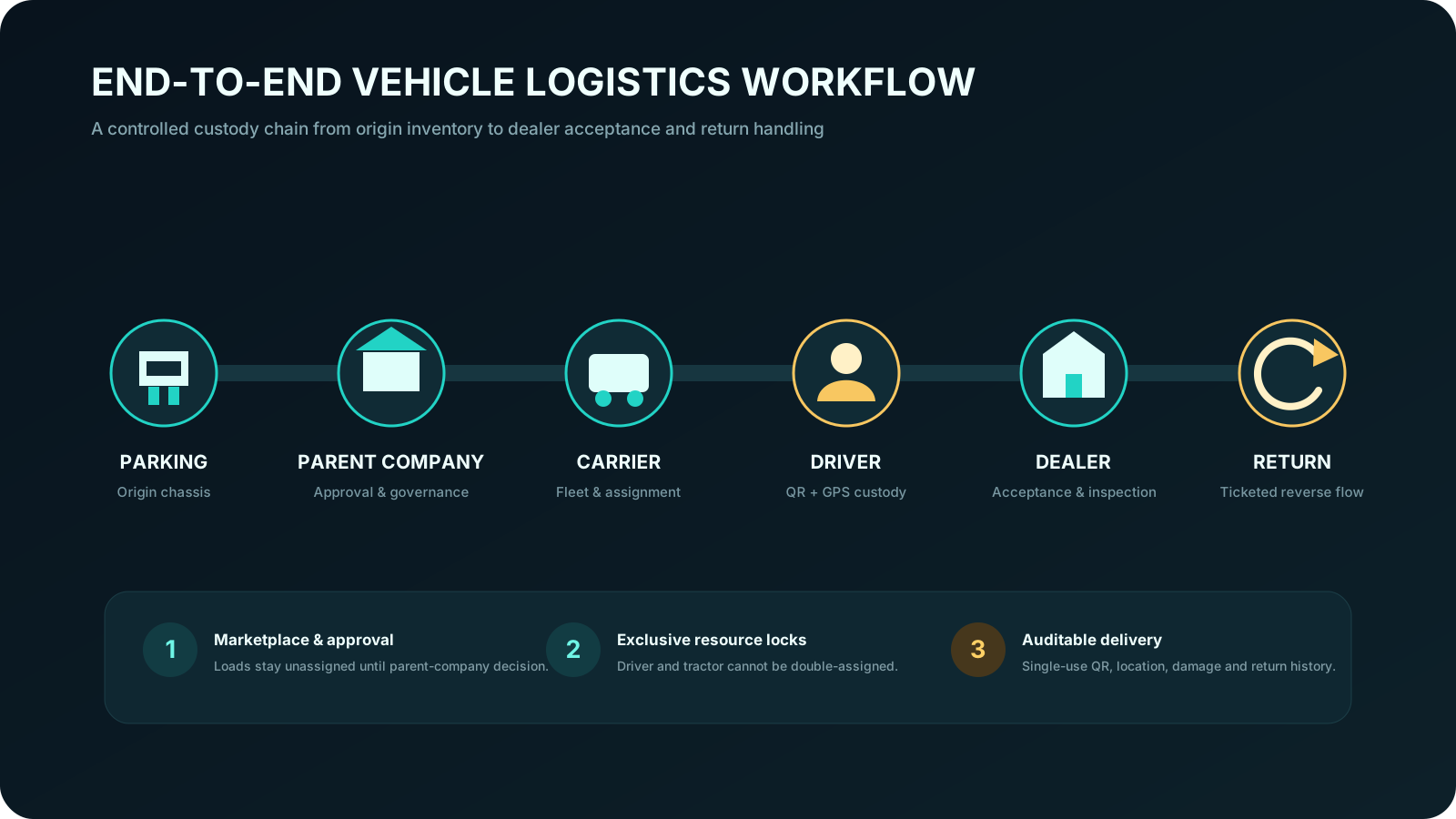
- Parent transportation company: governance, final approval, marketplace decisions and return decisions
- Operational carriers: tenant-scoped fleet and shipment execution
- Parking/origin terminals: chassis custody and origin handover
- Dealerships: destination acceptance, per-chassis review, damage and return requests
- Drivers: native Android workflow, marketplace, trips, QR and GPS
- Observers: broad read-only visibility for management, audit and demonstrations
Core modules
Shipment workflow and parent approval
Shipping has an explicit Draft → Pending Approval → Approved/Rejected workflow. Operational companies prepare work while the parent company retains final governance.
Controlled load marketplace
Dispatch requests can be published as MarketplaceLoad records. A MarketplaceClaim remains pending until the parent company approves it. Approval runs transactionally, rechecks global driver/truck availability, reserves resources, creates the final Shipping and rejects competing claims.
Exclusive driver and tractor engagement
DriverEngagement and TruckEngagement prevent the same driver or tractor from being assigned to multiple active shipments. The constraint is enforced server-side and resources are released only after destination delivery completes.
QR chain of custody
Pickup and delivery use short-lived, single-use random challenges bound to shipment, role, terminal and action. Raw QR secrets are not stored; only SHA-256 hashes are persisted. Production can require geofence validation. Custody events form an auditable append-only operational history.
Native Android driver app
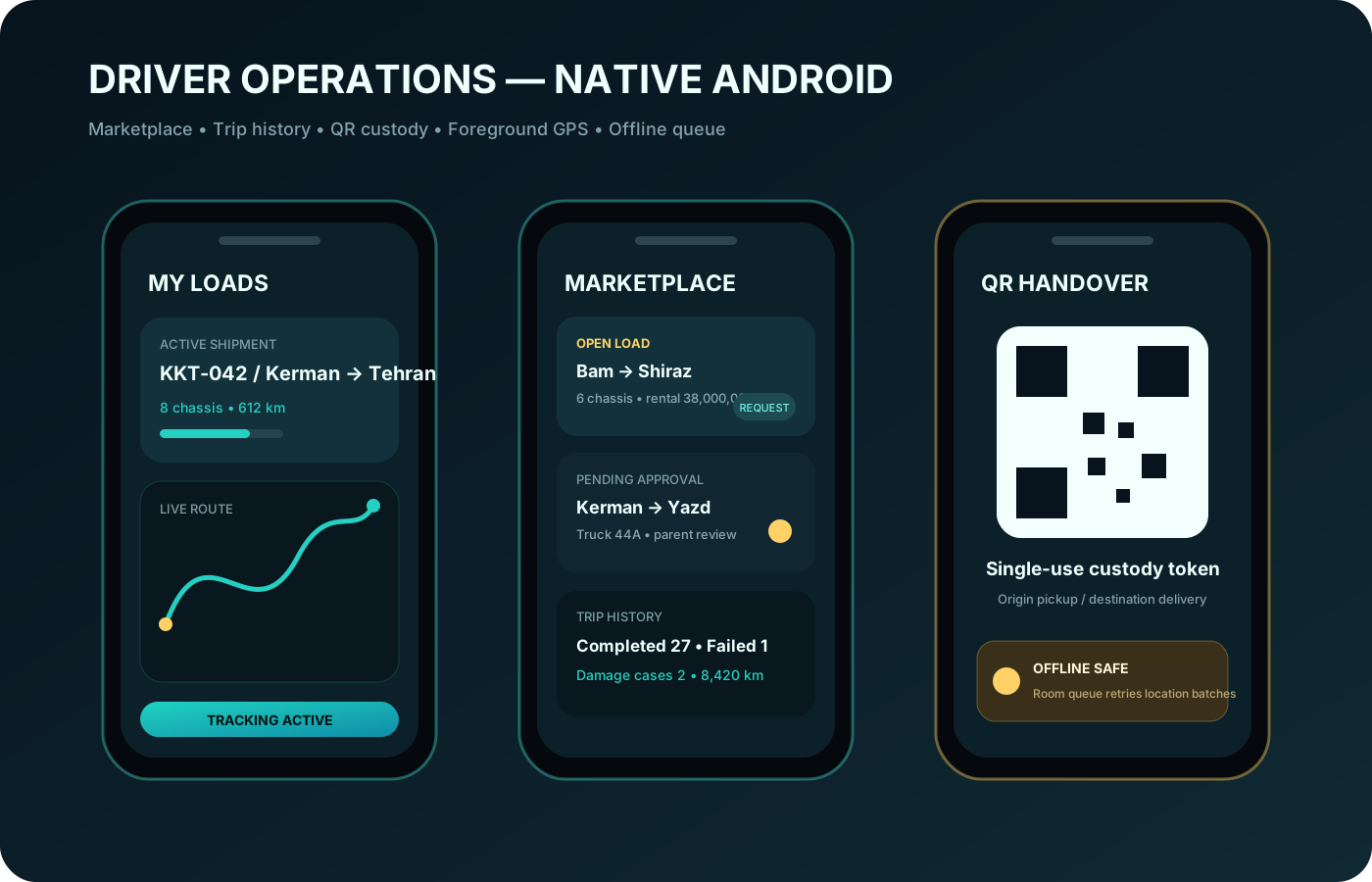
The Kotlin/Jetpack Compose app provides My Loads, Marketplace and Trip History. It integrates QR pickup/delivery, foreground GPS tracking, trip details, chassis/damage data and parent-approved marketplace requests.
Offline-first live tracking
Each accepted GPS point receives a UUID and is persisted to Room before upload. Network failures leave queued points intact; reconnecting uploads the original recorded timestamps in idempotent batches. This design is suitable for inter-city routes where connectivity cannot be assumed.
Dealer and per-chassis delivery
Each transported chassis is reviewed individually at the destination. Delivery status, receiver, coordinates, damage level/reason, notes and second-grade status are recorded per vehicle rather than only per truckload.
Returns and reverse logistics
A dealer return request creates a traceable workflow linked to a ticket. The parent company approves or rejects it and can choose a parking, dealership or city as the return target, keeping reverse logistics inside the same custody model.
Damage, inbox and reporting
Damage cases, internal ticket/inbox workflows and tenant-scoped reports provide operational evidence and management visibility. The data model is ready to integrate with insurance, finance and quality-control processes.
Engineering strengths
- Business invariants are enforced in the backend, not trusted to the UI
- Approval, GPS tracking and physical custody are separate state machines
- Offline-first Android tracking tolerates unreliable mobile networks
- Tenant-aware authorization also protects live WebSocket data
- Read-only Observer role supports management and audit use cases
- Single-use QR and append-only custody events improve traceability
- CI gates cover migrations, backend regression tests, frontend build/lint and Android builds
Business value for transportation companies
| Capability | Operational value |
|---|---|
| Parent governance + distributed execution | Central control without blocking day-to-day carrier operations |
| Exclusive resource locks | Prevents double booking of drivers and tractors |
| Controlled marketplace | Exposes open loads to available capacity while keeping approval authority |
| Digital chain of custody | Clear responsibility from parking to driver to dealer |
| Offline GPS queue | Preserves route history through connectivity gaps |
| Per-chassis delivery | Accurate acceptance and damage evidence for every transported vehicle |
| Reverse logistics | Return decisions and destinations remain traceable in the same platform |
| Unified reporting | Replaces fragmented operational spreadsheets with shared data |
| Web + API + Android | Covers office, terminal, dealership and road workflows |
These are product capabilities; quantified ROI or cost/time savings require each operator's real production data.
Technology
Backend: Django 5, Django REST Framework, SimpleJWT, Channels, Redis, Celery, SQL Server, object storage.
Web: Next.js 16, React 19, TypeScript, Redux Toolkit, Tailwind CSS and PWA capabilities.
Android: Kotlin, Jetpack Compose, Retrofit/OkHttp, Room, DataStore, Fused Location Provider and a foreground location service.
Infrastructure & security: Docker, Nginx, CI/CD, Cloudflare Turnstile, tenant-aware permissions, HttpOnly browser sessions and encrypted Android token storage.
Delivered result
KKT is not a simple CRUD transportation portal. It is an operations and vehicle-custody platform joining organisational governance, fleet resources, physical handover, mobile tracking, dealership acceptance and reverse logistics in one auditable system.
The portfolio scope is Completed — 100%. Stable release 1.6.0 is the baseline documented by this case study and the architecture is ready for field deployment and future release lines.
Discussion & comments
Loading comments...